The air conditioning cooling process can be divided into four steps: compression, heat release, throttling, and heat absorption. During the compression process, the low-temperature, low-pressure refrigerant enters the compressor, where it is compressed into high-pressure, high-temperature refrigerant gas.
It is then discharged from the compressor (at an outside temperature of 30°C, the refrigerant pressure is approximately 1.5 MPa and 70°C),
entering the condenser through the exhaust pipe. During the heat release process, the refrigerant enters the condenser,
where the engine cooling fan transfers a significant amount of heat to the condenser and then dissipates it into the air outside the vehicle.
This condenses the gaseous refrigerant into a high-pressure, medium-temperature refrigerant liquid
(at a temperature of approximately 57°C and a pressure of approximately 1.5 MPa).
This liquid then enters the receiver-drier, which acts as a moisture absorber and filter. During the throttling process,
the refrigerant then passes through the expansion valve to the evaporator. At this point,
the refrigerant is a low-temperature, low-pressure liquid (with some gas formed).
Upon exiting the expansion valve, the refrigerant liquid has a pressure of approximately 0.2 MPa and a temperature of 0°C,
making it highly susceptible to absorbing heat from the vehicle cabin (through air transfer).
Heat absorption process: After absorbing heat, the refrigerant liquid turns into a gas (at this point,
the refrigerant gas pressure is 0.2 MPa and the temperature is approximately 5°C), which then returns to the compressor. This cycle continues within the sealed system, continuously absorbing heat from the vehicle until the desired setpoint is reached.
In short, the compressor works to transfer heat between the interior and exterior,
or between the interior and exterior of the vehicle's passenger compartment, achieving both cooling and heating.


 ATCO Type Fittings
 Burgaflex Type Fittings
 Manuly Type Fittings
 E-Z Type Fittings
 FF AC Hose Fittings
 MF AC Fittings
 MIO AC Fittings
 SB-AC Fittings
 BL- AC Fittings
 RB- AC Fittings
 SR- AC Fittings
 Tube-AC Fittings
 FOR AC Fittings
 MOR AC Fittings
 Springlock Fittings
 Barb Fittings
 Bulkhead Fittings
 Splicer-Fittings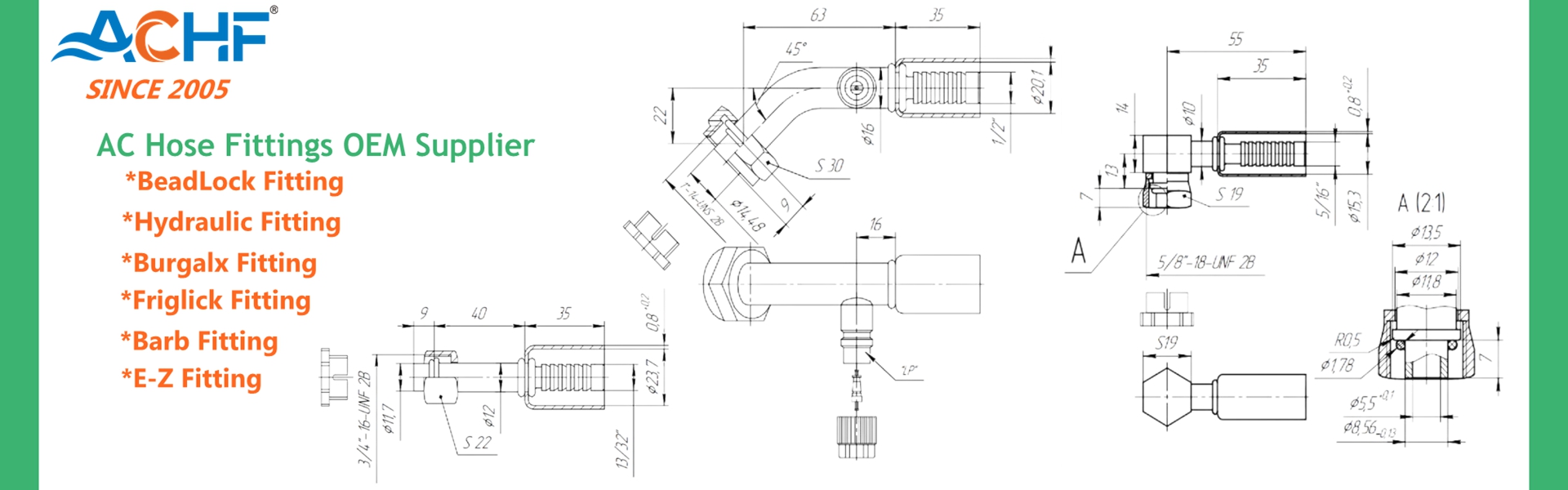
 0086-15356266629
 0086-0577-85335887
 0086-0577-85335886
 andy@lmacfitting.com


 andyshiuping
 0086-0577-85335887